
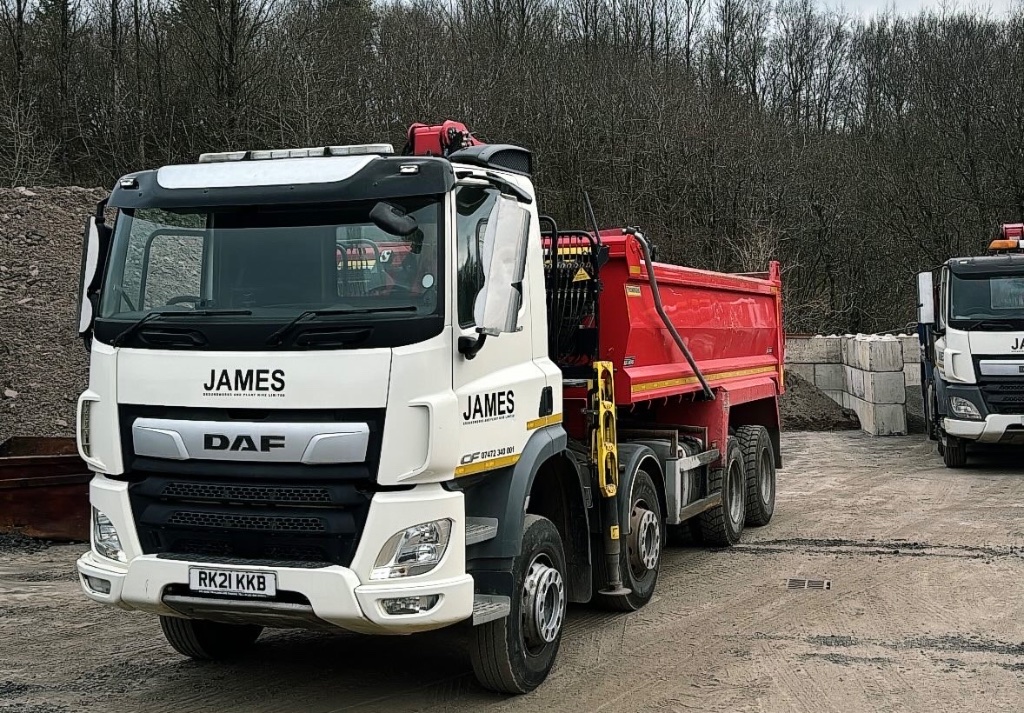
One of the most common questions we get before a grab hire job is: "How many loads will I need?" Understanding grab lorry capacity is key to budgeting your project accurately. This guide explains exactly how much soil each lorry carries and how to estimate loads for your specific excavation.
Grab Lorry Capacity — The Basics
Grab lorries come in two main sizes across South Wales. The choice between them affects how quickly your project is completed and the cost per load.
6-Wheel Grab Lorry
- • Weight capacity: up to 12 tonnes
- • Volume: approx. 7–8 cubic metres
- • Best for: residential streets, tight access
- • Equivalent to: approx. 2 large skips
8-Wheel Grab Lorry
- • Weight capacity: up to 16 tonnes
- • Volume: approx. 10–12 cubic metres
- • Best for: main roads, commercial sites
- • Equivalent to: approx. 3 large skips
Weight vs Volume — Why It Matters
Grab lorries are charged by load (lorry movement), but the actual amount of material per load depends on the weight, not just volume. Soil type makes a huge difference:
| Soil Type | Weight per m³ | Cubic metres per 16T load |
|---|---|---|
| Dry topsoil / sandy | 1.2–1.4 tonnes | 11–13 m³ |
| Standard topsoil | 1.4–1.6 tonnes | 10–11 m³ |
| Clay (dry) | 1.6–1.8 tonnes | 9–10 m³ |
| Clay (wet) | 1.8–2.0 tonnes | 8–9 m³ |
| Hardcore / rubble | 1.8–2.2 tonnes | 7–9 m³ |
| Concrete | 2.0–2.4 tonnes | 7–8 m³ |
How to Calculate Loads for Your Project
Use this simple formula to estimate how many grab lorry loads your excavation will require:
Loads = (Length × Width × Depth in metres) ÷ 10
Using 10 m³ per load as a conservative estimate for an 8-wheel lorry
Real Project Examples
Single-storey extension (4m × 5m × 0.6m deep)
Volume: 12 m³ — Estimated: ~2 loads (6-wheel) — Soil: Standard topsoil
Garage foundation (5m × 3m × 1m deep)
Volume: 15 m³ — Estimated: ~2 loads (8-wheel) — Soil: Mixed soil
Basement dig (6m × 8m × 2m deep)
Volume: 96 m³ — Estimated: ~10 loads — Soil: Clay soil — may need more
Garden landscaping / level (10m × 8m × 0.3m)
Volume: 24 m³ — Estimated: ~3 loads (8-wheel) — Soil: Topsoil
Driveway excavation (10m × 4m × 0.2m)
Volume: 8 m³ — Estimated: ~1 load (6-wheel) — Soil: Mixed
South Wales Soil Types
Soil type varies across South Wales, which affects load calculations. Cardiff's low-lying areas often have soft alluvial deposits and made ground. The Valleys typically feature heavy clay mixed with shale. Monmouthshire's rural areas have denser, more consistent soils. Newport's industrial heritage means brownfield sites can contain mixed rubble and made ground that's heavier than expected. If you're unsure what you'll dig through, allow extra loads in your budget — it's better to have fewer loads than expected than more.
Tips to Reduce the Number of Loads
- Reuse clean topsoil for landscaping elsewhere on site — only remove what you can't use
- Compact hardcore and rubble before loading — it settles and takes up less space
- Separate soil types — clean topsoil is cheaper to dispose of than mixed waste
- Use an 8-wheel lorry where access allows — fewer movements = lower overall cost
Frequently Asked Questions
How much soil fits in a grab lorry?
A 6-wheel grab lorry carries approximately 12 tonnes (around 8 cubic metres) of soil. An 8-wheel grab lorry carries up to 16 tonnes (approximately 10–12 cubic metres). Wet clay is heavier than dry topsoil, so volumes will vary depending on moisture content.
How many grab lorry loads do I need for my excavation?
Divide your excavation volume in cubic metres by 8–10 to get an estimate of loads needed. A typical house extension (3m x 5m x 1m deep) generates about 15 cubic metres — roughly 2 loads. A garage conversion or basement dig is usually 4–8 loads.
Can a grab lorry remove wet or heavy clay?
Yes. Grab lorries handle wet clay and heavy soils well. However, wet clay is significantly heavier than dry soil — up to 2 tonnes per cubic metre — so you may need more loads than expected. We weigh at the tip and charge accordingly.
Do you charge by load or by tonne?
We typically charge per load (per lorry movement). Each load is weighed at the licensed disposal facility. We'll give you an estimated cost based on your volume before work starts — there are no hidden charges.
Ready to Book Your Grab Hire?
Tell us your project dimensions and we'll give you an accurate load estimate and free quote.