
How to Plan Muck Away for a New Build in South Wales
Published March 2026 · 7 min read · James Grab & Tipper Hire
Poor muck away planning is one of the leading causes of cost overruns and programme delays on South Wales new build projects. This guide walks you through the planning process from ground investigation to final lorry load.
Step 1: Understand Your Ground Conditions
South Wales ground conditions vary significantly across the region. The valleys are predominantly clay and mudstone — heavy, moisture-retaining materials that bulk considerably when excavated. Coastal areas around Cardiff, Barry, and Penarth tend to have mixed soils with sand and gravel layers. Former industrial areas may have made ground with unpredictable composition.
A Phase 1 desk study identifies the site history and flags any contamination risk. For new builds on greenfield land, a basic soil assessment by your groundworker is usually sufficient. For brownfield and industrial sites, a Phase 2 intrusive investigation is essential before committing to a muck away contractor.
Step 2: Calculate Your Excavation Volume
Accurate volume estimation prevents the two most common muck away mistakes: under-budgeting (not enough lorry attendances booked) and over-budgeting (paying for lorries you don't need).
The basic formula is: Length (m) × Width (m) × Depth (m) = Volume in cubic metres
Then apply the bulking factor for your soil type:
- Clay / mudstone: 30–35% bulking — most common in South Wales valleys
- Sandy soil / loam: 20–25% bulking
- Rock: 30–40% bulking (broken rock expands significantly)
- Made ground / mixed: 25–35% bulking depending on composition
So if you excavate 100 cubic metres of clay, you need lorries to remove approximately 130–135 cubic metres of loose material.
Step 3: Convert Volume to Lorry Loads
To convert cubic metres to lorry loads, you need to know the density of your soil:
- Clay: approximately 1.6–1.8 tonnes per cubic metre (loose)
- Sandy soil: approximately 1.4–1.6 tonnes per cubic metre (loose)
- Mixed spoil: approximately 1.4–1.6 tonnes per cubic metre (loose)
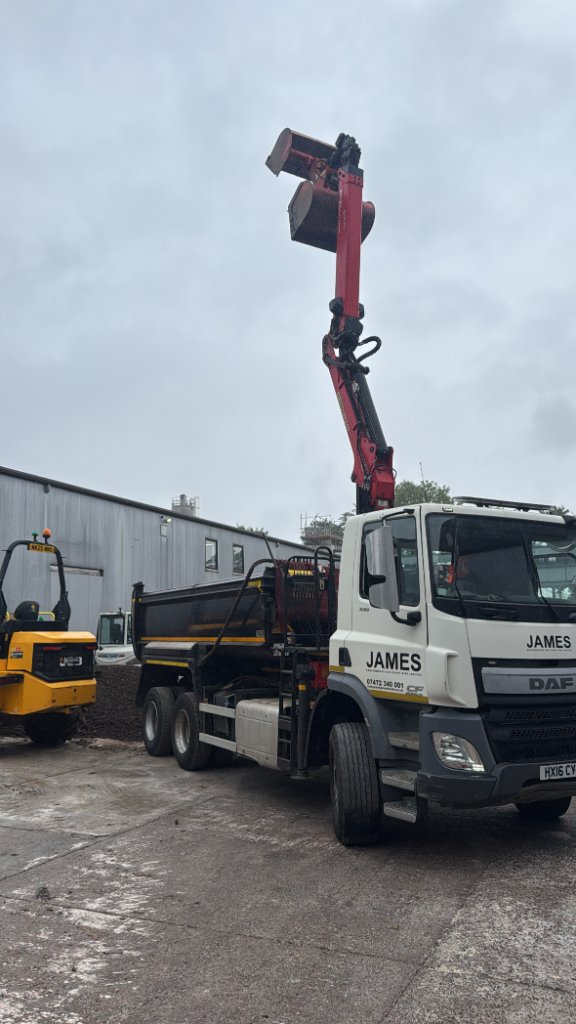
For a typical South Wales clay site: 130 cubic metres × 1.7 tonnes/m³ = approximately 221 tonnes. At 16 tonnes per 8-wheel grab lorry load, that's approximately 14 lorry loads.
Our muck away calculator on the muck away page does this automatically — enter your dimensions and soil type and it gives you the load count.
Step 4: Plan Your Lorry Schedule
For a small new build foundation — say, a 4-bedroom detached with strip foundations — you might need 10–20 lorry loads, which can typically be cleared in one or two full days. Book in advance and confirm with your groundworker so lorry attendances coincide with excavation progress.
For larger new build projects — housing developments, apartment blocks, commercial new builds — rolling muck away is essential. Establish with your muck away contractor: how many loads per day can be accommodated on site, what are the access restrictions, and what is the programme for the enabling works phase.
Step 5: Budget Accurately
Muck away costs in South Wales in 2025 typically range from:
- Clean topsoil: £200–£300 per grab lorry load
- Clay and mixed spoil: £250–£380 per load
- Contaminated soil (non-hazardous): £350–£500 per load
- Hazardous contaminated soil: £500–£800+ per load depending on contamination
These prices include driver, fuel, disposal fees, and Waste Transfer Note documentation. For accurate budgeting on your specific South Wales project, call us on 01495 820164 for a free quote.
Step 6: Book Your Muck Away Contractor Early
The South Wales construction market is busy. Good muck away contractors — especially those with sufficient fleet capacity for large new build projects — get booked up. For major projects requiring 50+ loads, book 4–6 weeks in advance. For smaller domestic new builds, 1–2 weeks notice is usually sufficient, though same-day service is available for urgent requirements.
Common Muck Away Mistakes to Avoid
Even experienced contractors make mistakes when planning muck away for new build projects. Here are the most common pitfalls and how to avoid them:
- Underestimating bulking factors: Clay and mudstone — the dominant soil types in South Wales valleys — bulk by 30–35% when excavated. Failing to account for this leaves you short on lorry capacity and extends your programme.
- Not identifying contamination early: If contamination is discovered after excavation begins, disposal costs can triple. Always commission a Phase 2 site investigation on brownfield land before mobilising plant.
- Booking a single-lorry contractor for large sites: If your contractor has only one lorry and it breaks down or is diverted, your site stops. Confirm fleet capacity and contingency arrangements before signing.
- Ignoring access restrictions: South Wales urban sites — particularly in Cardiff and Swansea city centres — often have weight limits, height restrictions, or time-limited access. Brief your contractor on all site constraints before booking.
- Not retaining Waste Transfer Notes: Waste Transfer Notes are a legal requirement under the Environmental Protection Act 1990 and must be retained for two years. Losing them creates compliance risk for your project.
Environmental Responsibility
Muck away is not just about removing waste — it's about responsible disposal. As licensed waste carriers, we ensure that excavated material is taken to licensed facilities where soil is screened and recycled wherever possible. Clean topsoil can be reused in landscaping; clay and inert material can be processed for use as fill; and only genuinely non-recyclable waste goes to landfill.
For new build projects targeting BREEAM or Code for Sustainable Homes ratings, demonstrating responsible waste management is essential. We provide tonnage and waste stream data to support your sustainability reporting and compliance documentation. Call 01495 820164 to discuss your project's environmental requirements.
Get a Muck Away Quote for Your South Wales New Build
Use our online calculator or call for a free, fixed quote tailored to your project.